

Introduction
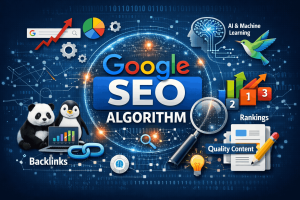
Google algorithms play the most important role in deciding which websites rank higher in search results. Every year, Google updates its algorithms to deliver better, more relevant results to users — and these updates directly shape how technology and SEO strategies must evolve. Understanding how Google algorithms work is essential for anyone who wants their website to succeed in search rankings. In this article, we’ll break down the key ways Google’s search technology are influencing modern SEO
practices in 2026.
1. E-E-A-T: What Google Algorithms Look For
Google algorithms now place heavy emphasis on E-E-A-T — Experience, Expertise, Authoritativeness, and Trustworthiness. This means Google rewards content written by people with real experience and knowledge on a topic, rather than generic or low-quality content.
To align with this part of Google’s search technology, websites should focus on publishing well-researched, accurate content, showcasing author credentials, and building trust through genuine, helpful information rather than keyword-stuffed articles.
2. Helpful Content Update and Google Algorithms
One of the most significant shifts in Google algorithms has been the introduction of the Helpful Content System. This update specifically targets content created primarily for search engines rather than real users. Google algorithms now detect and demote content that feels artificial, repetitive, or unhelpful.
For website owners, this means SEO strategy must shift from “writing for Google” to “writing for people” — while still following basic SEO structure like proper headings and keyphrases.
3. Core Web Vitals: A Technical Ranking Factor
Google’s search technology also evaluate technical performance through Core Web Vitals — metrics that measure page loading speed, interactivity, and visual stability. Websites that load slowly or shift content unexpectedly while loading are penalized by Google’s ranking system.
Improving these technical factors — through better hosting, optimized images, and clean website code — is a direct way to align with what Google’s search technology prioritize.
4. AI and Machine Learning in Google’s Ranking System
Modern Google’s search technology rely heavily on artificial intelligence and machine learning to understand search intent and context, rather than just matching exact keywords. This means Google can now recognize synonyms, related topics, and the overall meaning of content — not just literal keyword matches.
This shift requires SEO strategies to focus on comprehensive, topic-based content that thoroughly answers user questions, rather than narrowly targeting a single keyword.
5. Mobile-First Indexing in Google Algorithms
Google algorithms primarily use the mobile version of a website for indexing and ranking, known as mobile-first indexing. If a website isn’t optimized for mobile devices, it can significantly hurt search rankings, regardless of how good the desktop version looks.
Ensuring responsive design, fast mobile loading times, and easy navigation on smartphones is now a core requirement to satisfy Google’s ranking criteria.
Conclusion
Google’s search technology continue to evolve, placing greater emphasis on quality, trustworthiness, technical performance, and genuine user experience. Staying updated with these changes and adapting SEO strategies accordingly is essential for maintaining strong search rankings. By focusing on what Google use truly value — helpful content, technical excellence, and real expertise — website owners can build a sustainable, long-term SEO strategy that performs well no matter how future updates unfold.
 talha111